
Stephan G. Stephansson
The Icelandic-Canadian farmer, poet, essayist, social prophet, and pacifist Stephan G. Stephansson, was born on October 3rd, 1853, at Kirkjuhóll in Skagafjörður, Iceland (named Stefán Guðmundsson). In 1873, he emigrated from Iceland with his parents Guðmundur Stefánsson (1818‒1881) and Guðbjörg Hannesdóttir (1830‒1911), and his sister Sigurlaug Einara Guðmundsdóttir (1860‒1936). Stephan G. became a settler in Wisconsin and the Dakota Territories until 1889 when he left to homestead with his family in Markerville, Alberta. His wife was Helga Sigríður Stephansson (née Jónsdóttir) (1859‒1940), and they had seven children: Baldur Stephansson (1879‒1949); Guðmundur Stephansson (1881‒1947); Jón Stephansson (1884‒1887); Jakob Stephansson (1886‒1958), Stephaný Guðbjörg Stephansson (1889‒1940), Jóný Sigurbjörg Stephansson (1889‒1969), and Gestur Stephansson (1893‒1909).
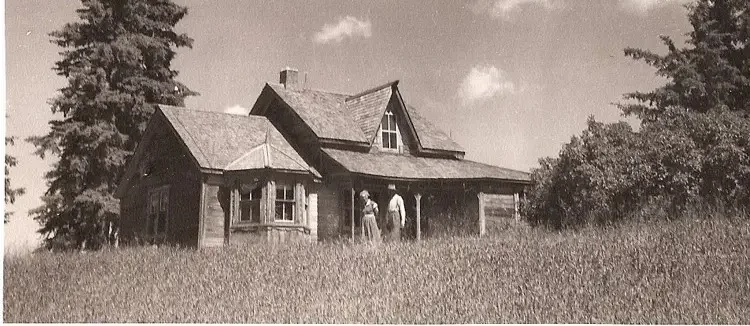
Stephan G. wrote exclusively in Icelandic and his creative engagement with Icelandic literature and its longstanding poetic tradition can be said to transcend that of many modern poets. Following his departure during the great wave of emigration from Europe to the Americas in the late 19th century, he also taught himself to travel through world literature and the philosophies of man and nature. Stephan G’s revelations of transcendental possibilities, including his unfaltering commitment to pacifism through and beyond the First World War, still resonate today in yet another age of destructive powers.
In his eulogy for Stephan G., (published on September 7th, 1927, in the Icelandic newspaper Heimskringla in Winnipeg, Canada), Halldór Laxness (1902–1988) stated that Stephan G. was one of the most powerful spirits of modernity. Halldór was not too optimistic, though, with regards to the reception of Stephan G.’s poetry in the non-Icelandic part of the world: “I don’t know if the outer world will ever become aware of the universes this poet has created in the minds of Icelandic readers. If we are to rely on our experience, the treasures of our language are not easily translatable.”
As manifested in Viðar Hreinsson’s groundbreaking book on Stephan G. Stephansson’s life and work, Wakeful Nights (2012), as well as in Two Lands, One Poet. Reflections of Stephan G. Stephansson Through Poetry (2019); a bilingual edition (Icelandic and English) of a selection of poems by Stephan G. edited by Birna Bjarnadóttir and Mooréa Gray, during his lifetime, Stephan G. did witness English translations of his poems from both sides of the Atlantic. In the twenty-first century, renowned translators of Icelandic literature have also contributed their share to the visibility of the transatlantic treasure. Still, a poem like “Vopnahlé” / “Battle-Pause” from 1915, which charts the killing fields of Europe during the First World War and has been referred to by John Ralston Saul in his foreword to Wakeful Nights as “the most important Canadian” anti-war poetry, is scarcely known in the “outer world.”
Should one blame it all on a self-inflicted cultural isolation that accompanies the usage of a language, which only an infinitesimal fragment of humanity speaks? There is a paradox at work here regardless. Stephan G. Stephansson’s creative engagement with Icelandic literature and its longstanding poetic tradition transcends that of many other poets of modernity. Simultaneously, Stephan G. has been referred to as Ralph Waldo Emerson’s (1802–1882) disciple in the ranks of North American poets and philosophers, and his vision is also believed to be shaped by Henry David Thoreau (1817–1862). Thus, the young man who emigrated Iceland in 1873 on the wave of the mass exodus from Europe to the Americas, and who taught himself to traverse through Icelandic literature and Norse mythology, other works of world literature, and philosophy of man and nature, became equally engaged with the outer world as with his language and land of birth.
The Stephan G. Stephansson Endowment Fund, University of Iceland
With the endorsement of Vigdís Finnbogadóttir, President of Iceland 1980‒1996, and Dr. Jón Atli Benediktsson, former Rector of the University of Iceland, The Stephan G. Stephansson Endowment Fund was established on April 20th, 2017, at the opening of the Vigdís International Centre for Multilingualism and Intercultural Understanding ‒ UNESCO Cat. 2 Centre. The objective of the endowment is to commemorate the heritage of Icelandic emigrants and their descendants in North America through research and international collaborative projects. Stephan Vilberg Benediktson (1933 ‒2025), grandson of Stephan G. Stephansson, contributed the founding endowment in the poet’s memory. In addition to a contribution from the Government of Iceland, other donors include Heather Alda Ireland, and her late husband William Ireland (1934 ̶ 2023), Donald K. Johnson, Arni Thorsteinson, Oskar Sigvaldason, Susan Abbiati, Stephan Robert Benediktson, Paul David Benediktson, and Mooréa Gray.